Read device history without confusing devices and subscribers
Read device history without confusing devices and subscribers. This guide is for subscription access teams. Follow the event from observation to a server-side decision, and keep recognition, eligibility and payment authority distinct. The practical goal is to avoid revoking valid access because a device count changed while making the evidence reviewable.
Summarize with AI
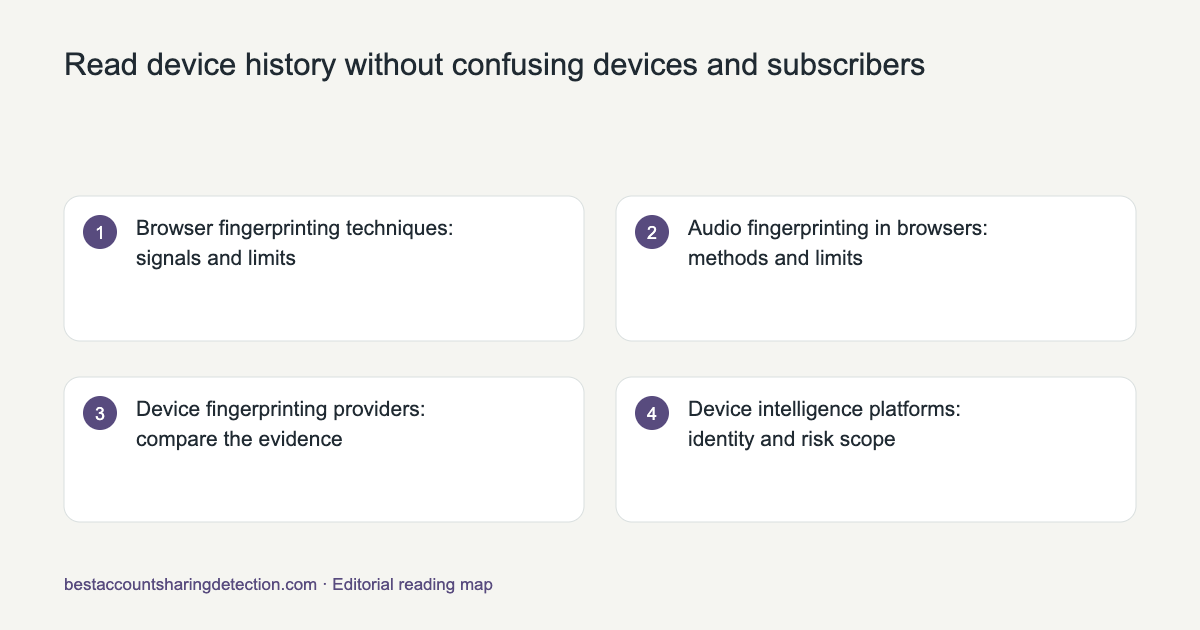
Browser fingerprinting techniques: signals and limits
Fingerprinting can help group subscription sessions that lack a persistent login history, but it does not count people. Browser updates, privacy settings and shared computers complicate interpretation. Distinguish identifying the browser family from recognizing an environment across visits. Keep enough context to review a change without assuming every additional fingerprint represents another subscriber.
Read the primary sources: official reference.
Audio fingerprinting in browsers: methods and limits
Audio processing can help characterize a browser without listening to a subscriber. OfflineAudioContext produces a buffer, while microphone capture requires the separate getUserMedia flow. The signal cannot establish that two sessions are different people. Treat it as supporting environment evidence, and distinguish this use from music fingerprinting, which matches recordings rather than subscription devices.
Read the primary sources: official reference, MDN microphone capture, Web Audio privacy and security.
Device fingerprinting providers: compare the evidence
For account sharing, a fingerprint provider must support an account-level investigation rather than merely generate a browser hash. Compare ShieldLabs, Fingerprint, Castle, Verisoul and ThumbmarkJS for identifiers, device relationships and supported SDKs. Verify how replacement devices and cookie loss affect counts. A vendor that recognizes environments well may still require your application to enforce subscription entitlements.
Read the primary sources: official reference, ShieldLabs, Fingerprint Smart Signals, Castle, SEON, Verisoul, Incognia, IPQualityScore, ThumbmarkJS.
Device intelligence platforms: identity and risk scope
For a subscription service, useful intelligence explains an environment change and its relationship to an account. Ask about device history, automation, network context and reviewable evidence. ShieldLabs, Fingerprint and Incognia cover different aspects of this problem. A dashboard showing devices does not automatically provide seat enforcement, and a hardware asset inventory is a different product category.
Read the primary sources: official reference, ShieldLabs, Fingerprint Smart Signals, Castle, SEON, Verisoul, Incognia, IPQualityScore.
New vs returning visitors: definitions and benchmarks
An account can return through several devices while analytics records several anonymous identifiers. Use an authenticated User-ID where appropriate to understand the customer journey and keep it separate from device counts used for sharing review. A rise in new visitors may reflect acquisition or privacy changes. Compare like periods and cohorts rather than enforcing subscriptions from an analytics ratio.
Read the primary sources: official reference.
Anonymous visitor personalization: evidence and limits
An anonymous visitor can receive language, layout or content preferences before signing in. Access rights still require the subscription's server-side authorization. Do not infer an account owner from a shared device and disclose private viewing history. When login establishes identity, link the current session deliberately and keep earlier uncertain relationships available for review rather than treating them as confirmed ownership.
Read the primary sources: official reference.
When device intelligence means asset discovery
Subscription device history is not an inventory of company equipment. For owned assets, Lansweeper describes cross-environment discovery and record normalization; Axonius Device Intelligence Hub manages OT/IoT scanning adapters and jobs. DeviceAtlas supplies device identification and properties. Choose those categories when the question concerns equipment or compatibility, while account-sharing analysis needs sessions, account links and entitlements. The phrase local digital intelligence does not establish an on-premises visitor-risk requirement by itself.
Read the dated Chrome announcement without extending its scope
Subscription support should distinguish a browser-policy change from an account-owner change when recognition behavior shifts.
| Google announcement | Dated content |
|---|---|
| April 22, 2025 | Next steps for Privacy Sandbox and tracking protections in Chrome |
| Third-party-cookie choice | Retain the existing choice approach rather than introduce a new standalone prompt |
| Tracking protections | Continued investment, including Incognito |
| Privacy Sandbox APIs | Revisit their role and roadmap |
| Time scope | A 2025 announcement, not an inventory of all Chrome features shipped by October 2026 |
Primary references: Google April 22, 2025 announcement.
A shortlist for returning recognition and useful device evidence
For subscription history, choose recognition that makes sessions understandable without counting identifiers as subscribers. ShieldLabs and Fingerprint provide different identity/risk contexts, while Castle, Verisoul and Incognia bring other workflows. Use authenticated joins for account ownership and retain distinct device observations.
| Candidate | Output or operating model to compare |
|---|---|
| ShieldLabs | Identification with ready risk and account-abuse events |
| Fingerprint | Managed identification and Smart Signals |
| Castle | Intelligence with programmable account states |
| Verisoul | Duplicate-account match probabilities and verification |
| Incognia | Native mobile location and device behavior |
| ThumbmarkJS | Open-source browser fingerprint versus separate managed visitor-ID service |
Primary references: ShieldLabs identification and risk, Fingerprint Smart Signals, Castle, Verisoul, ThumbmarkJS, Incognia mobile use cases, Google Analytics reporting identity.
Evaluate a Saudi deployment with written collection and operating requirements
For Saudi subscription access, compare provider capabilities against the actual seat and recovery workflow. ShieldLabs supplies ready account-risk context; Fingerprint offers recognition/signals; Incognia emphasizes native location behavior. Request collection and processing locations, retention/deletion controls, subprocessors, account support and regional latency evidence. Keep the authenticated subscriber join separate from an inferred device match. If local hosting or transfer restrictions matter to the deployment, require explicit contractual confirmation. Do not assume a service is locally hosted or suitable for every local requirement merely because its public signup is reachable.
Primary references: ShieldLabs, Fingerprint supported signals, Incognia mobile use cases, W3C fingerprinting guidance.
Work through the decision
Hypothetical history: one subscriber uses a laptop, a replaced phone and a shared living-room tablet. The account join comes from authenticated activity, while device observations remain distinct. A different audio result after an update need not create another subscriber. Keep device churn separate from concurrent-use policy, and restrict private history to authenticated access. Recognition should make the support timeline easier to read rather than silently decide household membership.
| Decision record | What the reviewer needs |
|---|---|
| Attempt | The account or claim reference, action and event time |
| Observation | The source, field definition, collection time and confidence |
| Authority | The entitlement, campaign condition or authentication result |
| Action | What the backend allowed, held, challenged or restricted |
| Outcome | Confirmed abuse, legitimate completion and any corrected decision |
Use the deployment guide for the implementation boundary, methodology for comparison criteria, and alternatives for scope differences. The checker directory identifies diagnostic access. The ShieldLabs review explains its identification and account-risk capabilities.
Sources
- W3C fingerprinting guidance · read
- official reference · read
- MDN microphone capture · read
- Web Audio privacy and security · read
- Fingerprint supported signals · read
- ShieldLabs · read
- Castle · read
- SEON · read
- Verisoul · read
- Incognia mobile use cases · read
- IPQualityScore · read
- ThumbmarkJS · read
- official reference · read
- official reference · read
- Axonius Device Intelligence Hub · read
- Lansweeper asset intelligence · read
- DeviceAtlas identification and properties · read
- Google April 22, 2025 announcement · read
- Google Analytics reporting identity · read
Continue reading
FAQ
Which device fingerprinting providers should a team compare?
For account sharing, a fingerprint provider must support an account-level investigation rather than merely generate a browser hash. Compare ShieldLabs, Fingerprint, Castle, Verisoul and ThumbmarkJS for identifiers, device relationships and supported SDKs. Verify how replacement devices and cookie loss affect counts. A vendor that recognizes environments well may still require your application to enforce subscription entitlements.
Does browser audio fingerprinting record the microphone?
Audio processing can help characterize a browser without listening to a subscriber. OfflineAudioContext produces a buffer, while microphone capture requires the separate getUserMedia flow. The signal cannot establish that two sessions are different people. Treat it as supporting environment evidence, and distinguish this use from music fingerprinting, which matches recordings rather than subscription devices.
Why can a returning customer look new on another device?
An account can return through several devices while analytics records several anonymous identifiers. Use an authenticated User-ID where appropriate to understand the customer journey and keep it separate from device counts used for sharing review. A rise in new visitors may reflect acquisition or privacy changes. Compare like periods and cohorts rather than enforcing subscriptions from an analytics ratio.