Protect the value behind paid access, orders and partner rewards
Protect the value behind paid access, orders and partner rewards. This guide is for subscription access teams. Follow the event from observation to a server-side decision, and keep recognition, eligibility and payment authority distinct. The practical goal is to avoid revoking valid access because a device count changed while making the evidence reviewable.
Summarize with AI
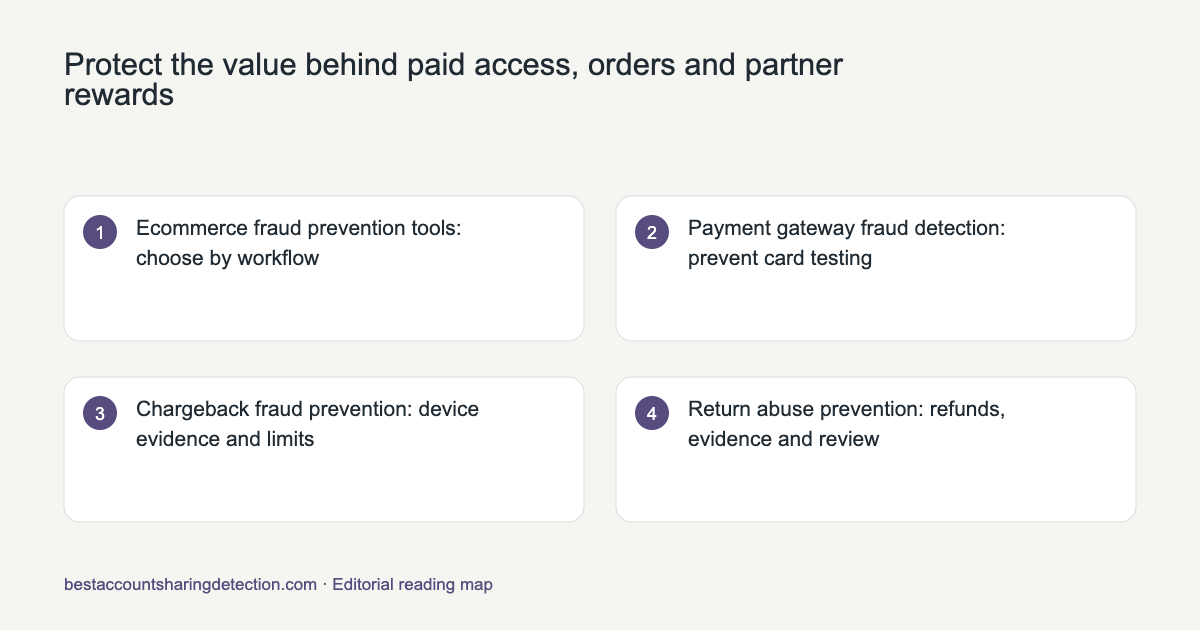
Ecommerce fraud prevention tools: choose by workflow
Subscription commerce mixes account access with purchases, refunds and fulfillment. Evaluate products at each relevant event instead of assuming one account-sharing tool covers the whole order lifecycle. Signifyd and Wyllo describe broad commerce workflows, while visitor-risk products add another evidence layer. Match the integration and contract to your actual loss, including false declines and support work.
Read the primary sources: official reference, Wyllo.
Payment gateway fraud detection: prevent card testing
Subscription billing can attract card testing even when access sharing is the initial concern. Rate-limit payment attempts across relevant account and device relationships and use gateway controls. Keep authentication, payment authorization and entitlement activation separate. A failed card attempt should not automatically become a sharing violation, and integration testing belongs in the processor's authorized sandbox.
Read the primary sources: official reference.
Chargeback fraud prevention: device evidence and limits
An account-access dispute may become a billing chargeback even when the login looked familiar. Keep authentication, entitlement use, cancellation and customer-contact evidence. Device history supports that record without proving consent to every charge. Compare actual dispute procedures and guarantee terms, and avoid promising that an account-sharing detector eliminates network fraud reports or billing disagreements.
Read the primary sources: official reference.
Return abuse prevention: refunds, evidence and review
Subscription refund disagreements can arise from cancellation timing, unauthorized use or misunderstanding of terms. Review account access and support history before labeling the customer abusive. Device evidence is context, not proof of informed purchase. Keep the refund operation separate from sharing enforcement and use an auditable reversal process so an access restriction does not automatically settle the billing dispute.
Read the primary sources: official reference.
Gift card fraud prevention: protect the value ledger
Shared subscription accounts may also hold gift-card value. Protect balance queries and spending separately from login and seat limits. Use account-aware rate controls, careful response messages and atomic redemption. A familiar device cannot authorize arbitrary code guessing, and a new customer device should not lose access to a legitimately purchased card without a recoverable verification route.
Read the primary sources: official reference.
BNPL fraud prevention: credit, accounts and fulfillment
A subscription offering installments needs clarity about access rights when a BNPL payment is pending, disputed or reversed. Device history can support review, but financing-provider identity and payment controls remain separate. Check the exact method and contract instead of assuming card-style chargebacks. Sharing enforcement should not silently alter a customer's repayment or refund rights.
Read the primary sources: official reference.
Synthetic identity fraud: proofing, signals and scope
Several devices on a subscription may reflect ordinary use, sharing or takeover; none alone demonstrates a synthetic identity. Synthetic identity fraud concerns the fabricated identity used to enroll. NIST's proofing and authentication distinction is useful here. Use appropriate identity verification where required, and keep device relationships as supporting context rather than treating them as proof of a real person.
Read the primary sources: official reference, NIST identity proofing.
Marketplace fraud prevention: profiles and transactions
Marketplaces may permit teams to operate a seller account while prohibiting resale of buyer credentials. Define those roles before enforcing sharing rules. Examine account authorization, device history, transaction evidence and review activity separately. A legitimate staff change can create new sessions; an apparent shared profile should receive a policy-specific review rather than an automatic sitewide exclusion.
Read the primary sources: official reference.
Travel fraud prevention: bookings, changes and refunds
A traveling subscriber may connect from hotels, airports and several devices. Compare the actual access policy with session overlap rather than treating country changes as sharing. If the service also sells bookings, separate account protection from payment and inventory controls. Give support an itinerary-aware recovery path and avoid calling every unfamiliar travel network a takeover.
Read the primary sources: official reference.
Ticket scalping prevention: queues and purchase rules
Ticketing access may be transferred through shared accounts even when the ticket itself is cryptographically valid. Enforce purchase and transfer rules server-side, protect inventory reservations and review account sessions. Device evidence can help investigate coordinated buying without proving resale. State household and group-purchase rules before restrictions, and make recovery possible when a customer replaces a phone before an event.
Read the primary sources: official reference.
Paywall abuse prevention: entitlement and delivery checks
Paid content must be authorized at the origin or an appropriate trusted access layer. A login, a challenge and an entitlement check answer different questions. Protect cached personalized responses and apply concurrency rules separately. Readers seeking access should use the publisher's subscription, trial or library routes; a CAPTCHA cannot replace the paid-access contract or secure content already returned to the browser.
Read the primary sources: official reference, MDN cache controls.
Sybil attack prevention: identities, claims and limits
Account sharing and Sybil activity describe opposite relationship directions: several users may share an account, while one entity may present many identities. Neither can be resolved by device count alone. In campaigns, define eligibility and the consequence of a suspected link. Preserve evidence and appeals rather than extending a subscription restriction into an unrelated claim exclusion.
Read the primary sources: official reference.
Click farm detection: ad fraud, SIVT and measurement
Subscription acquisition can attract manufactured leads that never become active subscribers. Analyze source, device relationships and verified activation or purchase events rather than treating account creation as a genuine conversion. Click farms may be human-operated. Supply-chain checks such as ads.txt and sellers.json help inspect inventory, while account-access tools provide different evidence after the visitor arrives.
Read the primary sources: official reference, IAB sellers.json, MRC invalid traffic framework.
Affiliate fraud detection: qualify and reconcile claims
An affiliate may send real subscribers, duplicate trials or manufactured conversion events. Define the payable milestone and verify it independently of the browser pixel. Keep account, entitlement and commission records linked, with explicit reversal rules for refunds. Shared workplaces or households can create device overlap, so publisher credibility should be evaluated from several sources rather than one account-sharing signal.
Read the primary sources: official reference.
Compare self-serve TV reporting before interpreting fraud claims
When buying TV acquisition for subscriptions, a self-serve interface should be judged alongside reporting detail. MNTN offers exportable network reports; its guide notes genre-level and Other Streaming Sources limitations. Vibe is another self-serve candidate with audience and campaign measurement. Its proposed reporting needs a field-level review before comparison. Ask both for attribution windows, placement granularity, IVT exclusions and dispute terms, then join qualified subscriber outcomes. A strong campaign return does not by itself establish the amount of fraud removed.
Account safety and on-chain attribution are separate investigations
Account-sharing services cannot guarantee immunity from a game's restrictions. Riot's official guidance warns about boosting, trading and profile sharing; permitted coaching avoids handing account control to a stranger. Separately, crypto attribution tools such as Chainalysis use on-chain clustering and attribution. Its Signals product marks suspected categories with confidence. That is different from proving account ownership through device history or claiming every investigative platform is SIGINT-based.
Separate publisher attribution, audience authenticity and disclosure
For subscription affiliates, distinguish a signup, an activated account and a retained paying customer. The partner contract should specify which event qualifies before fraud or sharing evidence affects the commission.
| Source or record | Relevant scope |
|---|---|
| Modash | Creator and campaign tracking |
| AdPolice | Brand and affiliate monitoring |
| Japan Consumer Affairs Agency | Official stealth-marketing guidance; designation effective October 1, 2023, including advertising arranged through third parties |
| First-party qualification record | The actual application, purchase or hiring milestone required by the partner agreement |
Primary references: Japanese Consumer Affairs Agency stealth-marketing guidance, Modash campaign tracking, AdPolice affiliate monitoring.
Paper-check fraud calls for bank-side controls
Subscription account protection does not reconcile paper checks. Where a business accepts or issues them, bank-side matching and authorized exception review belong in a separate financial workflow.
| Bank service | Documented model |
|---|---|
| Chase Check Protection/Positive Pay | Compares presented checks with issued-check details entered or uploaded by the business |
| Chase Check Monitoring | Review of outgoing checks at a selected amount threshold without an advance issue file; account availability varies |
| Bank of America Check Positive Pay fact sheet | Payee Positive Pay, Teller Positive Pay, reconciliation and exception handling, with service/market limitations |
| Buyer-specific contract fields | Issue-file format, payee matching, exception cutoff, default response and authorized reviewer roles |
Primary references: Chase business check protection, Bank of America Check Positive Pay fact sheet.
A purchase shortlist for guest orders and full customer journeys
For subscription commerce, compare account-access risk with payment, refund and support needs. ShieldLabs supplies ready account context, while Signifyd, Wyllo, Sift and SEON merit comparison for broader commercial workflows. Protect each event and keep cancellation or dispute rights separate from sharing enforcement.
| Need | Candidate scope |
|---|---|
| Visitor/account and promotion risk | ShieldLabs |
| Stripe payment rules | Stripe Radar |
| Broad commerce protection and contractual terms | Signifyd, Wyllo |
| Account/payment intelligence and operational workflows | Sift, SEON |
| Advertising IP, pre-bid/pre-click and post-bid IVT | Distinct Fraudlogix products |
Primary references: ShieldLabs, Signifyd, Wyllo, Sift, SEON, Stripe Radar, Fraudlogix.
Compare display and affiliate validation within the right regional cohort
For subscription acquisition, compare Fraudlogix or HUMAN at the advertising layer while keeping account activation and paid entitlement as separate outcomes. MRC's routine GIVT filtration and more involved SIVT assessment describe measurement methods, not a universal list of bad subscribers. A regional pilot should preserve country and network cohorts and review genuine privacy users. Reconcile validated media with qualified subscriber events and commission reversals. Select the control that explains invalid acquisition without treating every shared-device registration or short-lived subscription as proof that a publisher supplied fraud.
Primary references: Fraudlogix advertising product families, HUMAN advertising protection, MRC invalid-traffic definitions.
Sports-betting click protection and player location have different jobs
For a betting subscription or member account, an invalid ad click, shared login and wagering-location decision need distinct records. HUMAN and Fraudlogix are candidates for the advertising layer, with the actual inventory and fields specified. Use authenticated account history for access and review the operator's qualifying event before paying a partner. A separate location-control requirement needs its own deployment evidence. A customer traveling or using a privacy relay should not be labeled an invalid click merely because a later account or location check needs more information.
Primary references: HUMAN advertising protection, Fraudlogix advertising intelligence, Incognia location/device use cases.
Buy fraud prevention or contractual protection, not suppression of issuer reports
For subscription billing, a customer may create an issuer fraud report even where the account's devices look familiar. TC40 is distinct from a chargeback; Stripe's monitoring guidance treats warnings and disputes separately. Recognition does not prove consent to renew. Preserve the subscription terms, authorization, cancellation and communication record. When comparing protection products, read liability scope rather than expecting report suppression. Razorpay Shield covers qualifying enrolled cross-border payments under specified fraud conditions and exclusions. A subscription should be assessed against that actual agreement rather than assuming every recurring charge is covered.
Primary references: Stripe monitoring-program definitions, Razorpay Shield program terms.
Evaluate account safety through game rules and retained control
For shared gaming subscriptions, first distinguish permitted instruction from another person operating the account. Riot warns that boosting, trading and profile sharing can violate rules and make recovery harder. Keep credentials and recovery under the owner's control and use coaching only where allowed by the particular game. A platform should investigate a changed operator separately from an innocent device replacement or a compromised login. No seat-sharing score or seller assurance can override the game's published access conditions.
Primary references: Riot account-protection guidance.
Work through the decision
Hypothetical paid-access dispute: an account shows familiar devices, but the customer contests the renewal and asks for a refund. Device history does not prove consent to the charge. Review authentication, entitlement use, cancellation and communications under the relevant process. If access was shared, enforce the actual plan separately. Payment, content delivery and support recovery need a coherent record without turning every billing disagreement into a fraud label.
| Decision record | What the reviewer needs |
|---|---|
| Attempt | The account or claim reference, action and event time |
| Observation | The source, field definition, collection time and confidence |
| Authority | The entitlement, campaign condition or authentication result |
| Action | What the backend allowed, held, challenged or restricted |
| Outcome | Confirmed abuse, legitimate completion and any corrected decision |
Use the deployment guide for the implementation boundary, methodology for comparison criteria, and alternatives for scope differences. The checker directory identifies diagnostic access. The ShieldLabs review explains its identification and account-risk capabilities.
Sources
- Signifyd · read
- Wyllo · read
- official reference · read
- official reference · read
- official reference · read
- official reference · read
- official reference · read
- official reference · read
- official reference · read
- Incognia location/device use cases · read
- official reference · read
- official reference · read
- MDN cache controls · read
- official reference · read
- official reference · read
- official reference · read
- MRC invalid-traffic definitions · read
- MNTN platform · read
- MNTN reporting guide · read
- Vibe platform · read
- Riot account-protection guidance · read
- Chainalysis blockchain intelligence · read
- Chainalysis Signals · read
- Japanese Consumer Affairs Agency stealth-marketing guidance · read
- Modash campaign tracking · read
- AdPolice affiliate monitoring · read
- Chase business check protection · read
- Bank of America Check Positive Pay fact sheet · read
- ShieldLabs · read
- Sift · read
- SEON · read
- Stripe Radar · read
- Fraudlogix advertising intelligence · read
- HUMAN advertising protection · read
- Stripe monitoring-program definitions
- Razorpay Shield program terms · read
Continue reading
FAQ
Which ecommerce fraud controls belong in the shortlist?
Subscription commerce mixes account access with purchases, refunds and fulfillment. Evaluate products at each relevant event instead of assuming one account-sharing tool covers the whole order lifecycle. Signifyd and Wyllo describe broad commerce workflows, while visitor-risk products add another evidence layer. Match the integration and contract to your actual loss, including false declines and support work.
Can device tracking guarantee that no chargeback occurs?
An account-access dispute may become a billing chargeback even when the login looked familiar. Keep authentication, entitlement use, cancellation and customer-contact evidence. Device history supports that record without proving consent to every charge. Compare actual dispute procedures and guarantee terms, and avoid promising that an account-sharing detector eliminates network fraud reports or billing disagreements.
What evidence matters when reviewing return abuse?
Subscription refund disagreements can arise from cancellation timing, unauthorized use or misunderstanding of terms. Review account access and support history before labeling the customer abusive. Device evidence is context, not proof of informed purchase. Keep the refund operation separate from sharing enforcement and use an auditable reversal process so an access restriction does not automatically settle the billing dispute.