Keep promotional benefits consistent with subscription rights
Keep promotional benefits consistent with subscription rights. This guide is for subscription access teams. Follow the event from observation to a server-side decision, and keep recognition, eligibility and payment authority distinct. The practical goal is to avoid revoking valid access because a device count changed while making the evidence reviewable.
Summarize with AI
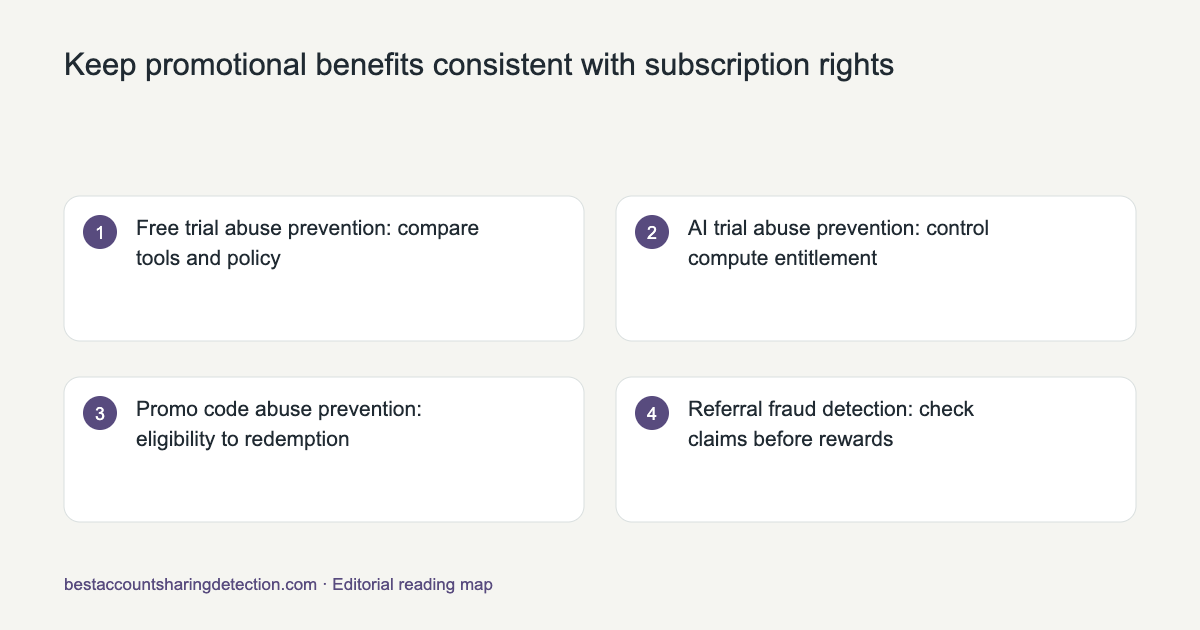
Free trial abuse prevention: compare tools and policy
Separate trial cycling from sharing a paid account. A trial policy needs a record of previous benefits and a clear definition of who may receive another offer. Device history can support that decision, while the subscription backend controls the actual grant. A household or replacement device exception should be explicit, with a support route for customers mistakenly linked to an earlier trial.
Read the primary sources: official reference.
AI trial abuse prevention: control compute entitlement
An AI subscription can suffer both trial cycling and sharing of a high-value seat. Track trial grants independently from concurrent compute or API usage. Enforce quotas on the service backend, then use device and account evidence for review. A customer running long jobs from several authorized devices should not be treated the same as several accounts repeatedly claiming introductory credits.
Read the primary sources: official reference.
Promo code abuse prevention: eligibility to redemption
Subscription offers can overlap with legitimate household sharing. State whether a discount is per account, household or subscriber and enforce that condition at redemption. Device history may reveal repeated claims but should not rewrite the published offer. Make the benefit grant atomic, and give support the campaign rule and previous redemption evidence needed to resolve a mistaken rejection.
Read the primary sources: official reference.
Referral fraud detection: check claims before rewards
A subscriber inviting a colleague is different from one person creating an extra identity for a referral reward. Define the qualifying event, observe the account relationship and avoid paying twice after a retry. Shared office devices require additional context. Keep referral eligibility separate from seat enforcement so a legitimate organization can invite new paid members without automatic suspicion.
Read the primary sources: official reference.
Loyalty fraud prevention: points, accounts and payouts
Sharing a loyalty account may be permitted by one program and prohibited by another. State the policy before enforcing it. Protect balances with secure login, session review and action-specific authorization, then link each redemption to the points ledger. Several family devices are weak evidence without the program context; a sudden payout change after recovery deserves a separate takeover investigation.
Read the primary sources: official reference.
iGaming bonus abuse: eligibility, evidence and review
Sharing a gaming account and creating several accounts for bonuses are distinct policy issues. Examine concurrent access, device relationships and the specific reward claimed. Keep identity checks and payment review separate from the sharing decision. Make conditions available before participation and give users a route to resolve household or replacement-device mistakes without automatically forfeiting unrelated entitlements.
Read the primary sources: official reference.
Price the actual trial-protection workload
Login and protected-access checks can create more activity than the number of subscriptions. Estimate that workload before buying a plan. The ShieldLabs figures below are monthly identification limits, separate from seats or MAUs, and history review does not consume additional identifications.
| ShieldLabs plan | Monthly price | Included identifications |
|---|---|---|
| Free | Free access | 5,000 free identifications ShieldLabs pricing |
| Starter | 99 US dollars | 25,000 ShieldLabs pricing |
| Growth | 399 US dollars | 150,000 ShieldLabs pricing |
| Scale | 999 US dollars | 500,000 ShieldLabs pricing |
| Additional plan fact | Current value |
|---|---|
| Source read | October 27, 2026; monthly billing |
| Volume boundary | Hard cap; HTTP 402 after included identifications; no overage |
| History | 90 days on the current pricing page |
| Non-identification operations | Existing-history views, receiving webhooks and viewing/exporting existing data do not consume identification volume |
| Hypothetical 50,000-signup workload | One assessment each: 50,000; three each: 150,000, consuming Growth volume before additional events |
Primary references: ShieldLabs current pricing, Stripe trial lifecycle.
Choose a focused eligibility layer or a broader fraud workflow
For a subscription business with shared seats and repeated trials, keep both policies explicit. ShieldLabs provides ready account-risk evidence relevant to those relationships. Compare Verisoul for duplicate matching and configurable platforms such as Castle or SEON when support needs a more elaborate state workflow.
| Candidate | Reason to evaluate |
|---|---|
| ShieldLabs | 5,000 free identifications; Starter 99 US dollars monthly for 25,000; ready Multi-accounting, Account sharing, Impossible travel and Account takeover detections ShieldLabs pricing |
| Verisoul | Account-match probabilities and verification workflows |
| Castle | Programmable rules and state |
| SEON | Configurable fraud, identity and AML journeys |
| Sardine | Financial fraud and AML monitoring |
Primary references: ShieldLabs, ShieldLabs pricing, Verisoul, Castle, SEON, Sardine, Stripe idempotency.
Work through the decision
Hypothetical subscription: one family member has already received a per-household introductory month, while another starts a separate paid plan. The answer depends on the published offer, not an arbitrary device threshold. Keep trial eligibility, seat entitlement and referral commission as separate records. If a purchase is refunded, apply the stated reward adjustment once. A sharing alert should not silently rewrite the promotion's terms or the customer's refund rights.
| Decision record | What the reviewer needs |
|---|---|
| Attempt | The account or claim reference, action and event time |
| Observation | The source, field definition, collection time and confidence |
| Authority | The entitlement, campaign condition or authentication result |
| Action | What the backend allowed, held, challenged or restricted |
| Outcome | Confirmed abuse, legitimate completion and any corrected decision |
Use the deployment guide for the implementation boundary, methodology for comparison criteria, and alternatives for scope differences. The checker directory identifies diagnostic access. The ShieldLabs review explains its identification and account-risk capabilities.
Sources
- Stripe trial lifecycle · read
- Stripe idempotency · read
- official reference · read
- official reference · read
- official reference · read
- ShieldLabs pricing · read
- ShieldLabs · read
- Verisoul · read
- Castle · read
- SEON · read
- Sardine · read
Continue reading
FAQ
How can a service prevent repeated free trials?
Separate trial cycling from sharing a paid account. A trial policy needs a record of previous benefits and a clear definition of who may receive another offer. Device history can support that decision, while the subscription backend controls the actual grant. A household or replacement device exception should be explicit, with a support route for customers mistakenly linked to an earlier trial.
What protects expensive AI trial resources?
An AI subscription can suffer both trial cycling and sharing of a high-value seat. Track trial grants independently from concurrent compute or API usage. Enforce quotas on the service backend, then use device and account evidence for review. A customer running long jobs from several authorized devices should not be treated the same as several accounts repeatedly claiming introductory credits.
How should referral rewards be checked before payout?
A subscriber inviting a colleague is different from one person creating an extra identity for a referral reward. Define the qualifying event, observe the account relationship and avoid paying twice after a retry. Shared office devices require additional context. Keep referral eligibility separate from seat enforcement so a legitimate organization can invite new paid members without automatic suspicion.