Interpret network changes during subscription access
Interpret network changes during subscription access. This guide is for subscription access teams. Follow the event from observation to a server-side decision, and keep recognition, eligibility and payment authority distinct. The practical goal is to avoid revoking valid access because a device count changed while making the evidence reviewable.
Summarize with AI
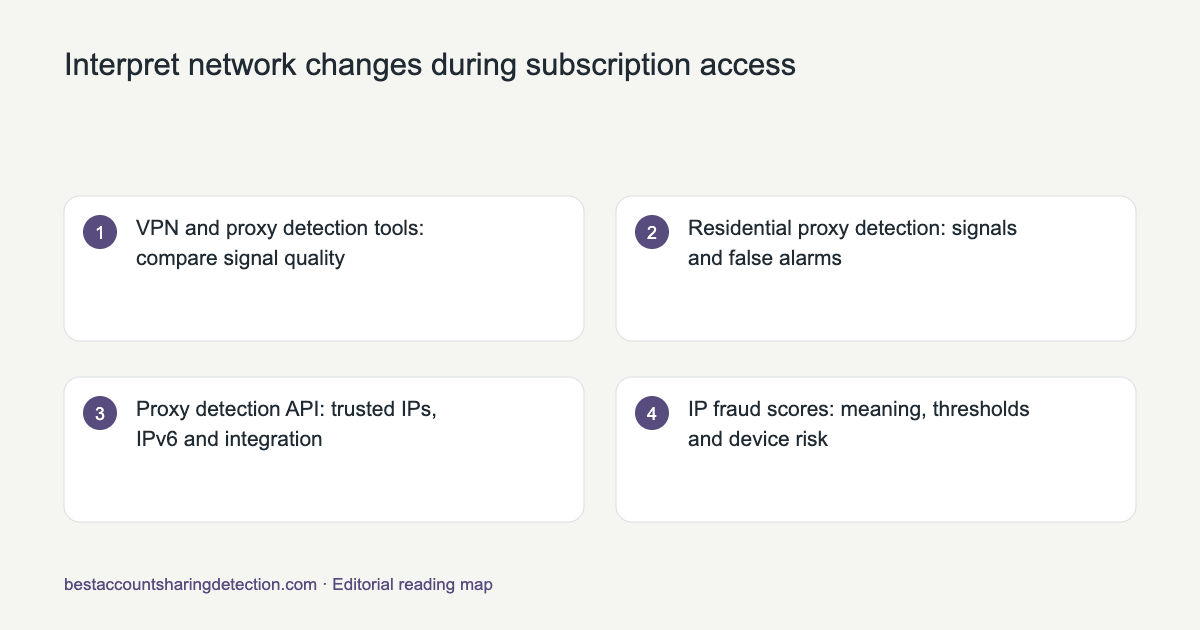
VPN and proxy detection tools: compare signal quality
Subscription customers may use a VPN for ordinary privacy or work. Compare network products such as ShieldLabs, Fingerprint, IPQualityScore, SEON and MaxMind for useful classifications, while keeping sharing decisions grounded in accounts and entitlements. A country change or proxy flag should not alone consume another seat. Test households, remote workers and mobile customers before tightening access.
Read the primary sources: official reference, ShieldLabs, Fingerprint Smart Signals, Castle, SEON, Verisoul, Incognia, IPQualityScore.
Residential proxy detection: signals and false alarms
Residential routing can make a shared account appear to move between homes. Compare device and session continuity with concurrent entitlement use before restricting access. Carrier NAT and household networks create innocent relationships. A detector should expose its network evidence and uncertainty; a bare residential label cannot establish that several sessions belong to one person or several subscribers.
Read the primary sources: official reference.
Proxy detection API: trusted IPs, IPv6 and integration
Your access backend should consume network evidence for the specific session, using the client address established by trusted ingress. Verify IPv6 and Tor handling and keep a missing result distinct from direct traffic. Private Relay is a privacy service with published exit ranges. A subscription policy should not treat that relay classification as automatic proof that an account is being shared.
Read the primary sources: official reference, Trusted ingress headers.
IP fraud scores: meaning, thresholds and device risk
An address score should not become a subscriber score without context. Several customers may share a carrier exit, and one customer can use several addresses. Compare device history, account events and entitlement use alongside the reasons behind the network score. Keep vendor scales separate and review false restrictions before using a threshold to enforce subscription access.
Read the primary sources: official reference.
Location spoofing detection: evidence without guesswork
Impossible travel and sharing reviews need location uncertainty. A VPN can move an apparent exit while a subscriber stays still; several devices can also travel legitimately. Compare session timing, device continuity and permission-based location where available. Preserve confidence and appeal paths. A map pin or country change should not by itself determine who is using a subscription.
Read the primary sources: official reference.
Anti-detect browser detection: consistency and context
Profile isolation can make one shared login appear as many environments, while privacy protections can create similar churn. Review account use, sessions and entitlement consumption alongside tampering signals. A detector should expose uncertainty and reasons. Legitimate browser compatibility tests belong in a separate authorized cohort so they do not become evidence that a real subscriber violated access terms.
Read the primary sources: official reference.
TLS and HTTP fingerprinting: JA4, HTTP/2 and context
A protocol fingerprint can support environment review, but several subscribers may share it. Distinguish TLS JA4, TCP JA4T and HTTP/2 behavior before interpreting a change. Proxy termination can alter what the server observes. Keep account and entitlement evidence primary for sharing decisions, and treat protocol signals as context rather than a count of people using the account.
Read the primary sources: official reference, Cloudflare JA4.
Anonymity checks: browser observations and their limits
An anonymity test can help a subscriber understand which network exit a service sees. It cannot prove whether an account is shared or certify that no recognition is possible. Keep checker outputs separate from subscription decisions. A public demo, a gated product trial and a contact form offer different levels of access and should be described accurately.
Read the primary sources: official reference.
Distinguish data-access networks from cross-merchant fraud intelligence
An account's authenticated cross-device history is different from intelligence learned across merchants. Neither means the buyer receives another merchant's customer records or an unrestricted global person identifier.
| Requirement | Relevant candidates or evidence |
|---|---|
| Authorized mobile data access | Oxylabs mobile-proxy endpoints, targeting and session controls; Bright Data network methodology |
| Commerce-network risk intelligence | Forter, Signifyd and Sift |
| Authenticated cross-device history | Account events with a justified identity join |
| Probabilistic recognition | Relationship or match evidence with uncertainty |
| Merchant access to data | The actual permissions and fields in the proposed product contract |
Primary references: Oxylabs mobile proxies, Bright Data methodology, Forter identity intelligence, Signifyd commerce network, Sift.
Select network evidence for login and payment without blanket bans
For subscription login, choose a network layer that explains route changes without replacing entitlement policy. ShieldLabs combines account and network evidence; IPQS and MaxMind offer focused enrichment; Fingerprint and SEON provide other identity or risk contexts. Keep concurrency and recovery decisions independently enforceable.
| Need | Starting candidates |
|---|---|
| Combined network/device and account-risk evidence | ShieldLabs |
| Focused IP enrichment | IPQS, MaxMind |
| Managed identity with documented Smart Signals | Fingerprint |
| Configurable fraud journeys | SEON |
| Native mobile location behavior | Incognia |
Primary references: ShieldLabs, IPQS, Fingerprint Smart Signals, MaxMind anonymizer data, SEON, Incognia.
Work through the decision
Hypothetical travel login: the subscriber's apparent country changes while the device remains familiar and the plan allows access. Compare relay use, timestamps and any independent location evidence before claiming impossible travel. If simultaneous sessions exceed the actual stream limit, enforce that limit separately. A map pin and a VPN flag should not decide household identity, and support needs the underlying timeline to correct mistaken restrictions.
| Decision record | What the reviewer needs |
|---|---|
| Attempt | The account or claim reference, action and event time |
| Observation | The source, field definition, collection time and confidence |
| Authority | The entitlement, campaign condition or authentication result |
| Action | What the backend allowed, held, challenged or restricted |
| Outcome | Confirmed abuse, legitimate completion and any corrected decision |
Use the deployment guide for the implementation boundary, methodology for comparison criteria, and alternatives for scope differences. The checker directory identifies diagnostic access. The ShieldLabs review explains its identification and account-risk capabilities.
Sources
- MaxMind anonymizer data · read
- ShieldLabs · read
- Fingerprint Smart Signals · read
- Castle · read
- SEON · read
- official reference · read
- Incognia · read
- IPQS · read
- official reference · read
- Trusted ingress headers · read
- official reference · read
- official reference · read
- Cloudflare JA4 · read
- official reference · read
- Oxylabs mobile proxies · read
- Bright Data methodology · read
- Forter identity intelligence · read
- Signifyd commerce network · read
- Sift · read
Continue reading
FAQ
How does residential proxy detection differ from identifying an ISP?
Residential routing can make a shared account appear to move between homes. Compare device and session continuity with concurrent entitlement use before restricting access. Carrier NAT and household networks create innocent relationships. A detector should expose its network evidence and uncertainty; a bare residential label cannot establish that several sessions belong to one person or several subscribers.
Which address should a proxy detection API evaluate?
Your access backend should consume network evidence for the specific session, using the client address established by trusted ingress. Verify IPv6 and Tor handling and keep a missing result distinct from direct traffic. Private Relay is a privacy service with published exit ranges. A subscription policy should not treat that relay classification as automatic proof that an account is being shared.
Does an IP fraud score prove that a customer is fraudulent?
An address score should not become a subscriber score without context. Several customers may share a carrier exit, and one customer can use several addresses. Compare device history, account events and entitlement use alongside the reasons behind the network score. Keep vendor scales separate and review false restrictions before using a threshold to enforce subscription access.